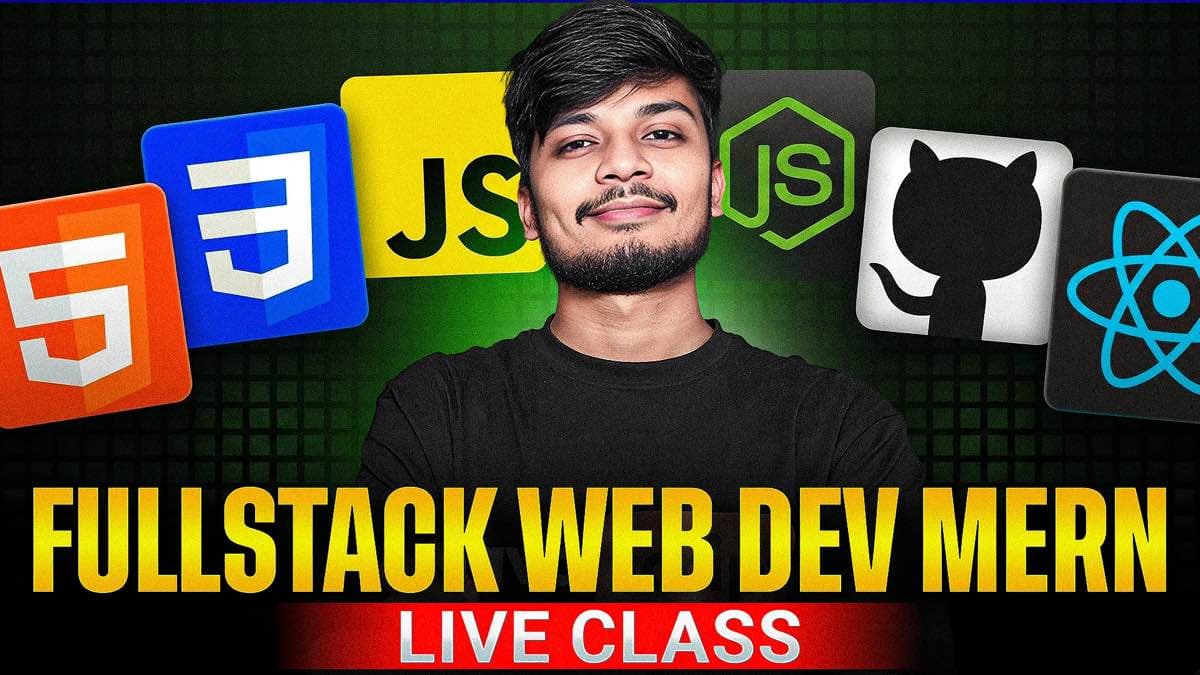

Join our live evening classes with hands-on projects, mentorship, and interview-focused career support. Build a professional portfolio, master modern tooling, and get help with placements and internships. Recordings are available indefinitely so you can learn at your own pace.
Start Date
Duration
Class Schedule
Class Timings
Doubt Class
Course Validity

Semantic HTML & accessibility
Layouts, Flexbox, Grid
Utility-first styling
Core language + DOM
Hooks, state, routing
Component primitives & patterns
Routing, SSR, App Router
Get mentored by a professional software engineer with real-world experience

Senior Software Engineer & Mentor

Software Engineer with expertise in NEXT, Angular, React, Node.js, SQL, API, Cloud, DevOps, etc.
Angular Certified Level 3 Developer
Winner of 6 hackathons with proven problem-solving skills
Mentored over 7000+ students with exceptional results
Published 4 research papers at international conferences
Delivered 20+ real-time projects for diverse clients
Branch Topper in B.Tech (AKTU) with CGPA of 8.6


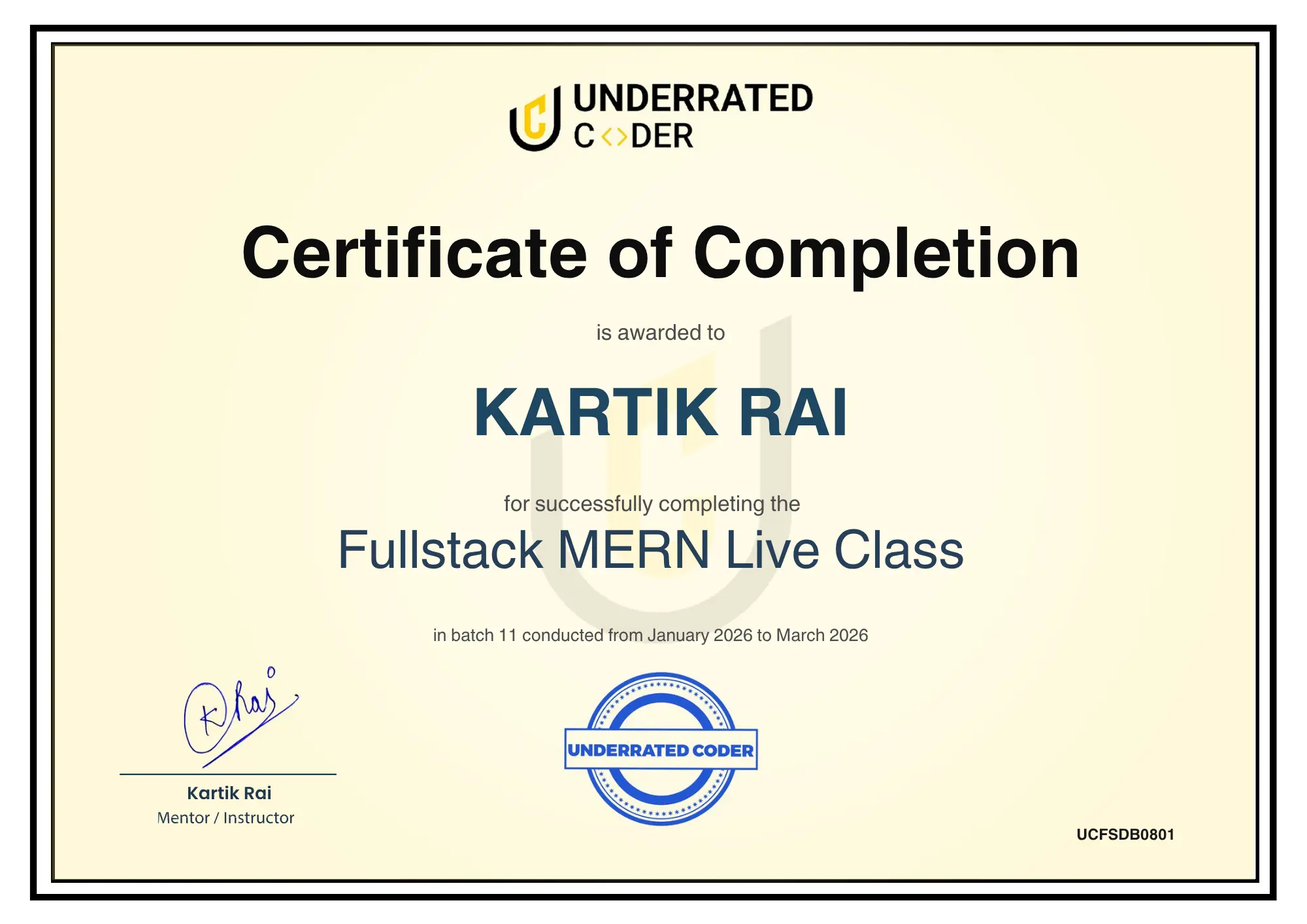
Fullstack MERN Live Class
Everything you need to know about the course, curriculum, and career support.
Yes, this Coding Live Class is designed from the ground up for beginners. No prior coding knowledge is required. Your success is dependent on consistent attendance and dedicated practice, and our curriculum is structured to guide you every step of the way.
Let me be honest with you. If you're a college student right now, you're probably seeing job posts asking for "Full Stack Developer" everywhere. Companies want people who can build an entire website—from the buttons users click to the database that stores their information. That's what full stack means, and that's exactly what we're going to teach you in this live class.
This isn't a boring lecture series. For the next three months, we meet Monday to Friday, every evening from 10 PM to 11 PM. Why that time? Because I know you have college during the day. After your classes, assignments, and maybe some time to relax, we'll spend one focused hour building real websites together. And on weekends—Saturday and Sunday at 10 PM—we hold doubt-clearing sessions where you can ask anything that confused you during the week.
The best part? This is a live interactive program. You're not buying a bunch of videos to watch alone. You're joining a class where you can stop me mid-explanation and ask, "Wait, why did we use useState here?" or "Can you show that API call again?" Real-time learning, real-time answers. Plus, every class gets recorded, so if you miss Monday's session or want to rewatch something, it's all saved for you—forever.
Complete beginners who've never written code before but want to learn web development from scratch—we literally start with "What is HTML?"
College students in 1st, 2nd, or 3rd year who want to build real projects for their resume and stand out during campus placements
Students from non-CS backgrounds (Mechanical, Civil, Electronics) who want to switch to tech—this course requires zero prior coding knowledge
Final year students preparing for placements who need a strong portfolio and practical skills to crack interviews at service-based and product companies
Anyone who wants to freelance or build their own startup—knowing full stack means you can build MVPs and side projects without hiring developers
Monday to Friday, 10 PM to 11 PM. One hour every day where we build together. No marathons, no burnout—just consistent, focused learning. Weekend doubt sessions on Saturday and Sunday at 10 PM ensure no question goes unanswered.
Forget theory-heavy courses. We build actual websites—your portfolio, full-stack applications with authentication, database-driven projects. By the end, you'll have 4-5 live projects deployed on the internet that you can show recruiters.
We teach what companies actually use in 2026—Next.js (React framework), Node.js, Prisma ORM, Supabase, Tailwind CSS, and Shadcn UI. No outdated tutorials. This is the stack used by startups and product companies today.
Every single class is recorded and available forever. Missed a day? Watch the recording. Want to review React hooks six months later? It's all there. Plus, you get access to our private Discord community for ongoing support.
We start with the basics—HTML, CSS, and JavaScript. You'll learn how to create beautiful, responsive web pages that work on phones, tablets, and desktops. We cover Flexbox, Grid, and Tailwind CSS so you can style like a pro without writing messy CSS. By week 3, you'll understand JavaScript deeply—functions, arrays, objects, DOM manipulation, and event handling.
Week 4 is where it gets exciting. We dive into React.js—the library used by Facebook, Netflix, and thousands of companies. You'll learn components, props, state management with hooks, and React Router for multi-page apps. By the end of month 1, you'll build your first project: a fully functional, beautifully styled portfolio website that you can deploy and share with anyone.
Now we move to the backend. You'll learn Node.js—how to create servers, handle requests, and build APIs. We cover SQL databases so you understand how data is stored, queried, and managed. Then we introduce you to Supabase (a modern Postgres hosting solution) and Prisma (a type-safe ORM that makes database work easy and error-free).
You'll build full-stack applications where the frontend (React) talks to your backend (Node.js) which stores data in a database. We'll add authentication—login, signup, protected routes. This is where you start feeling like a real developer. By month 2, you'll have built at least 2 full-stack projects with working backends and databases.
Month 3 is all about leveling up. We teach you Next.js—a powerful React framework that companies love because it makes websites faster and SEO-friendly. You'll learn server-side rendering, API routes, the new App Router, and how to integrate Shadcn UI components for professional-looking interfaces.
We'll also cover Git and GitHub (how developers collaborate), Vercel deployment (hosting your projects for free), and interview preparation. You'll learn how to explain your projects confidently, how to write an ATS-friendly resume, and strategies for applying to jobs and internships.
The final weeks are dedicated to your capstone project—a fully functional full-stack web application built with Next.js, Node.js, Prisma, and Supabase. You'll deploy it live, add it to your portfolio, and use it as your centerpiece during interviews. This is what separates you from students who only have theory knowledge.
HTML & CSS: The foundation of every website. You'll learn semantic HTML for accessibility and modern CSS techniques including Flexbox and Grid. We also teach Tailwind CSS—a utility-first framework that lets you style faster without writing custom CSS files.
JavaScript: The programming language that powers the web. From basic syntax to advanced concepts like async/await, promises, and ES6 features. You'll be comfortable manipulating the DOM, handling events, and working with APIs.
React.js: The most popular frontend library. Master components, hooks (useState, useEffect, custom hooks), context API for state management, and React Router for navigation. This is what companies ask for in 90% of frontend roles.
Next.js: A React framework that makes your websites faster and SEO-friendly. Learn server-side rendering, static site generation, API routes, the App Router, and image optimization. Next.js is used by companies like Netflix, Twitch, and Uber.
Node.js: JavaScript on the server. Build RESTful APIs, handle HTTP requests, work with middleware, and understand the event loop. Node.js powers LinkedIn, Netflix, and PayPal's backends.
SQL & Databases: Learn how to design database schemas, write complex queries with joins, and understand relationships (one-to-many, many-to-many). We use Supabase—a hosted Postgres solution with built-in authentication.
Prisma ORM: A modern database toolkit that makes working with databases type-safe and error-free. Prisma generates types automatically, so you catch bugs before they reach production. It's the future of database tooling.
Git & GitHub: Version control is non-negotiable. Learn how to commit, push, pull, create branches, resolve merge conflicts, and collaborate with teams. This is how every company works.
Vercel & Deployment: Deploy your projects in minutes. Vercel is the hosting platform built by the creators of Next.js. We'll show you how to go from local development to a live website with a custom domain.
Shadcn UI: A collection of beautifully designed, accessible UI components built with Radix UI and Tailwind CSS. Instead of building buttons and modals from scratch, use pre-built components that look professional.
You might be wondering, "Why this stack? Why not PHP or Python or something else?" Great question. The MERN stack (MongoDB/SQL, Express, React, Node) is the most in-demand skill set for web developers right now. Here's why:
One language everywhere: JavaScript runs on the frontend (React), backend (Node.js), and database queries. You don't need to learn multiple languages.
Huge job market: Check any job board—Naukri, LinkedIn, AngelList. Most full-stack roles ask for React, Node, and MongoDB/SQL experience. This stack gets you hired.
Modern and scalable: Companies like Uber, Netflix, and PayPal use Node.js. Startups love React and Next.js. This isn't legacy tech—it's what's powering the web today.
Perfect for beginners: The learning curve is smooth. Start with HTML/CSS, move to JavaScript, then React, then Node. Each step builds on the previous one.
Adding Next.js to the mix makes you even more valuable. While many developers know React, fewer understand Next.js—yet it's becoming the standard for production apps because of its performance benefits and SEO capabilities. Learning Next.js sets you apart from the crowd.
Your online resume. Built with React and styled with Tailwind CSS. Includes sections for your bio, skills, projects, and contact form. Fully responsive and deployed live on Vercel. This is the first thing you'll show recruiters.
A complete CRUD (Create, Read, Update, Delete) application. Users can create accounts, log in, and manage their own data. Built with React frontend, Node.js backend, and Supabase database. Includes authentication and protected routes.
A more advanced project where you implement features like product listings, shopping cart, user profiles, and real-time updates. This demonstrates your ability to handle complex state management and database relationships.
Your final project—built with Next.js, Prisma, Supabase, and Shadcn UI. This is production-ready code with server-side rendering, optimized images, SEO, and deployment on Vercel. This project alone can land you interviews.
Learning full-stack development is not easy. There will be days when JavaScript makes no sense, or your API doesn't work and you can't figure out why. That's normal. Every developer—including me—goes through this. But here's the difference: you won't be alone.
We meet every weekday evening for one hour. That's enough time to learn something new without burning out. And on weekends, we have doubt-clearing sessions. Stuck on a bug? Confused about async functions? Bring it to the weekend class, and we'll debug it together. You also get lifetime access to recordings, so you can revisit any topic whenever you need.
Here's what I promise: if you show up consistently, do the assignments, and build the projects, you will become job-ready in three months. Not "I watched some tutorials" ready—actually ready. Ready to walk into an interview, talk about your projects, explain your code, and answer technical questions confidently.
This course isn't just about teaching you to code. It's about getting you hired. In the final weeks, we focus heavily on job preparation:
Resume Building: Learn how to write an ATS-friendly resume that passes automated filters and catches recruiter attention. We review your resume and give feedback.
Interview Preparation: Mock interviews, common JavaScript and React questions, how to explain your projects, and behavioral interview tips.
Job Application Strategies: Where to apply, how to reach out to recruiters on LinkedIn, how to ask for referrals, and how to approach startups directly.
Freelancing & Internships: If you want to work while studying, we'll show you how to find freelance gigs on Upwork, Fiverr, and Freelancer, or how to land internships at startups.
Plus, you'll be part of our private community even after the course ends. Many students from previous batches still ask questions, share job opportunities, and help each other. You're not just buying a course—you're joining a network of aspiring developers.
Let's be realistic. The live classes happen Monday to Friday, 10 PM to 11 PM. That's one hour daily—5 hours per week of live instruction. But to truly learn, you need to practice. I recommend spending another 5-7 hours per week coding on your own—doing assignments, building mini-projects, debugging your code.
So, total commitment: 10-12 hours per week. That's roughly 1.5-2 hours per day. It sounds like a lot, but think about it—how much time do you spend scrolling Instagram or watching random YouTube videos? This is an investment in your future. Three months of focused effort can change the trajectory of your career.
And here's the good news: the classes are late at night to fit your schedule. College during the day, relaxation in the evening, and coding at night. If you miss a class, the recordings are there. Life happens—exams, family events, bad internet days. We get it. That's why everything is recorded and saved forever.
If you're tired of tutorial hell, if you want to build real projects that impress recruiters, if you're serious about getting a job in tech—this program is for you. No fluff, no outdated content, just practical, hands-on learning that gets results.
Batch 10 launches on 2 May 2026. Join now, and in three months, you'll have a portfolio full of live projects, a skill set that companies want, and the confidence to apply for full-stack developer roles.
This is your chance to go from "I want to learn coding" to "I'm a full-stack developer with deployed projects." Let's build your future together.